
Australia and 9/11: How September 11 Changed Our Country Forever
When the planes hit the Twin Towers on September 11, 2001, Australia’s story changed forever. Prime Minister John Howard was right there in Washington when it happened. What he did next would change how Australia protects itself for the next 20 years.
Australia’s Quick Response to 9/11
Australian Prime Minister John Howard arrived in the United States on 8 September 2001 on an official working visit to commemorate the 50th anniversary of the ANZUS Treaty. From a Washington DC hotel only a few blocks from the White House, he witnessed America suffer an extraordinary attack on September 11.
Two days later, back in Canberra, Howard held a press conference with Downer and the Deputy Prime Minister, John Anderson, and announced that: “the federal cabinet…came very quickly to the view that the provisions of the ANZUS Treaty should be invoked in relation to the attack upon the United States.
This was a big moment in history. Despite being in operation for more than 60 years, the ANZUS treaty has only been formally invoked once. Then Australian Prime Minister John Howard did this in 2001 as a response to the September 11 terrorist attacks in New York and Washington, leading to Australia’s involvement in the United States led ‘War on Terror’.
How Many Australians Died in 9/11?
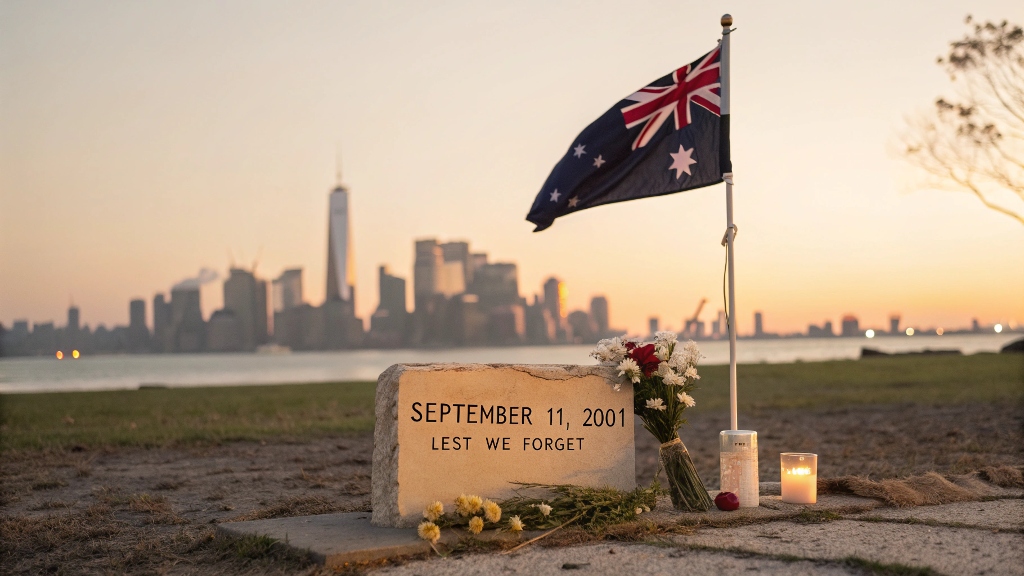
Ten Australians were among 2,977 people who died as a result of terrorism attacks in the United States on 11 September 2001. These ten people became part of a much larger story about how terrorism would touch Australian lives in the years to come.
The ANZUS Treaty Becomes Real
The ANZUS Treaty is an agreement between Australia, New Zealand, and the United States. It says that if one country gets attacked, the others will help. For 50 years, nobody had used this agreement. Then 9/11 happened.
On that flight, after discussion with his foreign minister, Alexander Downer, Howard decided Australia would invoke the ANZUS Treaty, for the first time, in a move that had its own symbolism, being done during the week celebrating its 50th anniversary. The prime minister also correctly presumed the Australian public and the Labor opposition, led by Kim Beazley, would be supportive.
Australia Goes to War
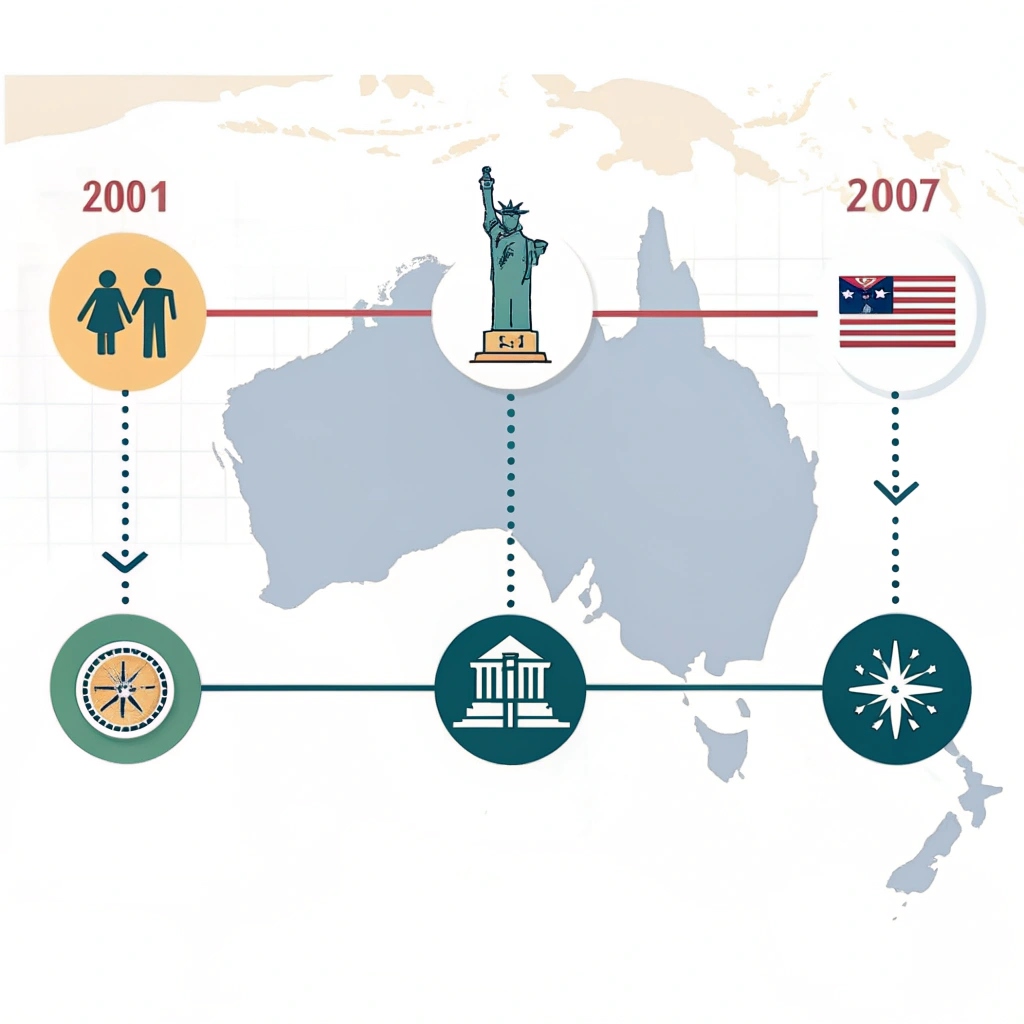
After invoking ANZUS, Australia joined America’s “War on Terror.” The US-led military response sent troops into Afghanistan to defeat Al-Qaeda and remove the Taliban from power. Australia sent special forces to Afghanistan in October 2001 to support US-led-coalition as Al-Qaeda were driven from much of the country.
This war lasted 20 years. During the 20-year involvement in the War in Afghanistan, 41 Australians were killed, and over 260 were wounded.
Terrorism Comes Closer to Home
Just over a year after 9/11, terrorism hit much closer to Australia. Little more than a year after the attacks on the US, the threat of terrorism was felt closer to home. The Bali bombings on the 12th of October 2002 carried out by Jemaah Islamiyah killed 202 people, including 88 Australians.
2002: Bali bombings kill 88 Australians This was the biggest loss of life in Australia since World War II. Until now, Australians had felt somewhat insulated from global terrorism.
New Laws to Fight Terrorism
Before 9/11, Australia had almost no laws about terrorism. After the attacks, this changed quickly. The government started making lots of new laws to keep Australia safe.
An example of a law that fits under category 1 is the Security Legislation Amendment (Terrorism) Act 2002 (Cth), which introduced a range of new terrorism offences into the Criminal Code Act 1995 (Cth) sch (‘Criminal Code’) in response to 9/11.
These laws kept growing after each terrorist attack. This was demonstrated most significantly with respect to the government’s package of anti-terror laws passed in response to the July 2005 London bombings. A difficulty in the anti-terror context in Australia over the last decade is that such laws have tended to be made as a reaction to terrorist attacks overseas which have provoked anger, fear and grief in the community. These have been magnified by the fact that a number of Australians have been killed in the attacks: 10 in the September 11 attacks; 88 in the 2002 Bali bombings; 1 in the 2005 London bombings; and 3 in the 2009 Jakarta hotel bombings.
John Howard’s Leadership During Crisis
Prime Minister John Howard was the right leader at a very difficult time. The Prime Minister, John Howard, who was in Washington on the day of the attack, rose to give one of his finest parliamentary performances, formally invoking the treaty provisions of Australia’s alliance with the US. It was a speech from the heart as well as the head.
Howard made it clear that Australia stood with America. If that treaty means anything, if our debt as a nation to the people of the United States in the darkest days of World War II means anything, if the comradeship, the friendship and the common bonds of democracy and a belief in liberty, fraternity and justice mean anything, it means that the ANZUS Treaty applies and that the ANZUS Treaty is properly invoked.
How 9/11 Changed Australian Security
The September 11 attacks changed how Australia thinks about safety. Before 9/11, most Australians felt safe from international terrorism. After 9/11, the government had to learn how to protect the country from new types of threats.
The Australian government and law enforcement agencies had to learn how to deal with terrorism. They wanted to prevent it in Australia and throughout the Asia-Pacific region.
The Australian Federal Police also changed. For the AFP, these events would evolve the agency literally overnight. We worked quickly to assemble expert investigative and forensic teams, as well as victim identification, media and family liaison units.
The Connection Between 9/11 and Bali
The Bali bombings weren’t just a separate event. Some of those who planned the bombings had trained in Afghanistan. This showed that the “War on Terror” was connected across many countries.
Australia’s Long War on Terror
Over 39,000 Australians were involved in supporting operations in Afghanistan. This was Australia’s longest war. It finally ended in 2021 when the last Australian troops left Afghanistan.
Australia’s last combat troops were withdrawn in December 2013, but around 400 stayed behind in training and advisory roles. The Australian embassy was closed on 28 May this year; the last troops and diplomats departed three weeks later.
What 9/11 Means for Australia Today
September 11, 2001 was a day that changed everything for Australia. It brought Australia into America’s longest war. It created dozens of new laws about terrorism. It changed how Australians think about safety and security.
Most importantly, it showed that Australia will stand with its friends when they need help. Without hesitation, he offered Australian assistance. In doing so, Prime Minister Howard invoked the ANZUS Treaty for the first time.
Twenty years later, Australia is still dealing with the changes that started on September 11, 2001. The country that woke up that Tuesday morning was different from the one that went to sleep that night. 9/11 didn’t just change America – it changed Australia too.