
Have you ever walked into a room and immediately felt something was off — not bad, just somehow unfinished? Nine times out of ten, I’d wager it’s the curtains. Or rather, the lack of proper ones. Flimsy pencil pleats drooping from a cheap rail. Eyelet panels that billow like a sail whenever someone opens a door. You know the ones.
Double pinch pleated curtains are the antidote to all of that. They’re the window dressing that makes a room look genuinely considered — like someone actually thought about the space, rather than grabbing the first thing off the shelf at a DIY superstore. And yet, for all their visual drama, they’re surprisingly achievable, whether you’re making them yourself, sourcing ready made pinch pleat curtains, or specifying them for a high-end project.
In this guide, I’ll cover everything: what makes the double pinch pleat special, how to measure and calculate widths, where to buy, and how to hang them properly. Including on bay windows, because that’s always where it gets interesting.
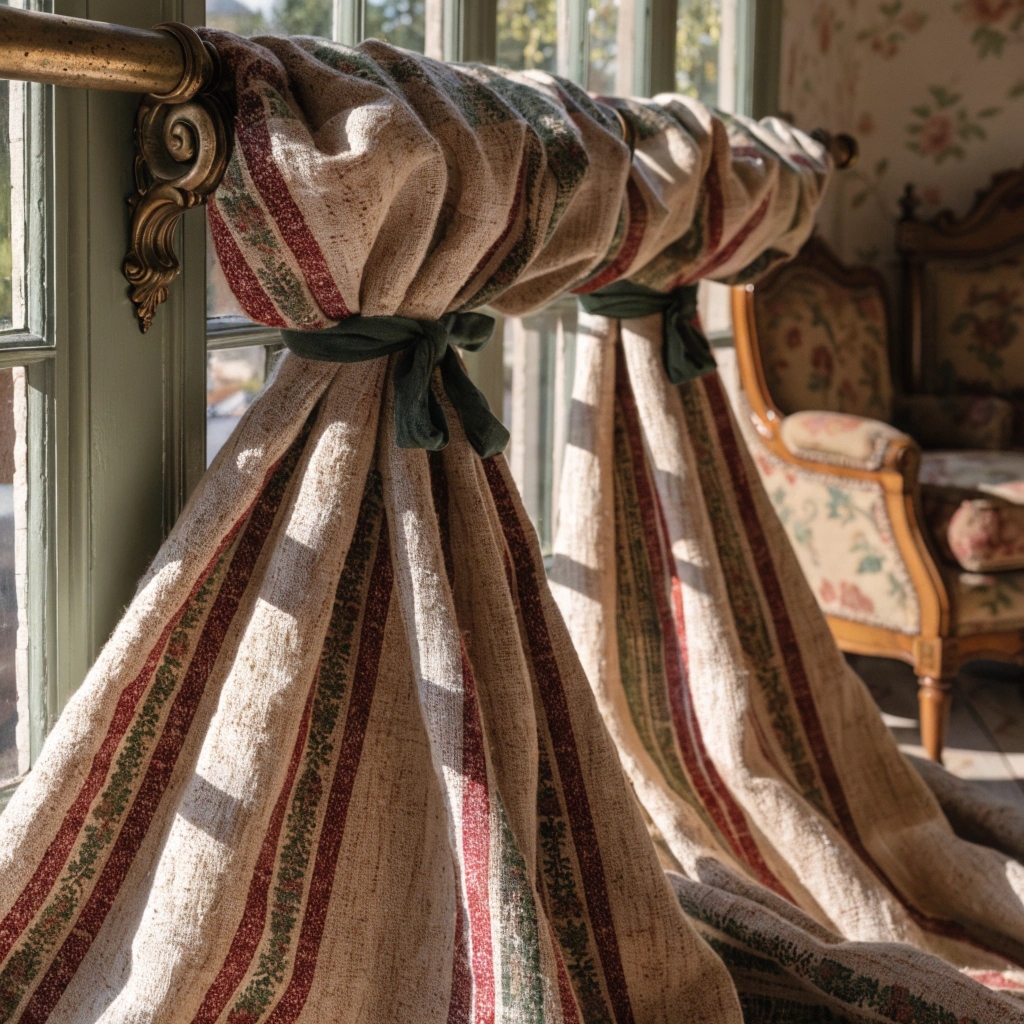
A pinch pleat is exactly what it sounds like: fabric that’s been pinched together and stitched at the base to create a neat, defined fold. The ‘double’ refers to the number of folds per pleat group — two folds, fanned out and secured at the bottom.
They sit somewhere between the more casual look of eyelet curtains and the full drama of triple pinch pleats. Double pleats give you that beautiful, even column of fabric as the curtain falls — substantial enough to look luxurious, restrained enough to not overwhelm a room.
Historically, they’ve been a staple in Georgian, Edwardian and Victorian interiors. Walk into any well-preserved period property in Britain and you’ll likely find them. They’ve simply never gone out of style because, honestly, they don’t need to.
| Feature | Double Pinch Pleat | Triple Pinch Pleat |
|---|---|---|
|
No. of folds per pleat |
2 |
3 |
|
Fabric required |
2× – 2.5× pole width |
2.5× – 3× pole width |
|
Visual weight |
Elegant, moderate fullness |
Very full, formal, opulent |
|
Best for |
Most rooms, period & modern |
Grand rooms, tall windows, hotels |
|
Cost of fabric |
Moderate |
Higher (more fabric needed) |
|
DIY difficulty |
Moderate |
More complex |
For most British homes — a Victorian terrace living room, a suburban semi’s bay window, a flat with decent ceiling height — double pinch pleats hit the sweet spot. Triple pleats are magnificent, but they demand serious fabric investment and a room grand enough to carry them without looking stuffed.
Fabric calculation is where many people go wrong, so let’s be precise. For double pinch pleated curtains, you need 2 to 2.5 times the finished width of your curtain track or pole. I’d lean towards 2.5× for heavier fabrics and 2× for lighter linens or voiles.
Step-by-Step Width Calculation
- Measure your pole or track width(the full span, including any overlap at the centre).
- Multiply by 2.25as a reliable middle-ground fullness ratio.
- Add 16cm for side hems(8cm each side), plus any pattern repeat allowance.
- Divide by your fabric width(usually 137cm or 150cm) and round up to the nearest whole number to get your width count.
Example: A 240cm pole × 2.25 = 540cm + 16cm hems = 556cm ÷ 137cm fabric = 4.06 → round up to 5 widths per curtain pair (or 2–3 per panel).
| Pole/Track Width | Fullness Ratio | Total Fabric Width Needed | Fabric Widths (137cm cloth) |
|---|---|---|---|
|
150cm |
2.25× |
~354cm |
3 widths |
|
200cm |
2.25× |
~466cm |
4 widths |
|
250cm |
2.25× |
~578cm |
5 widths |
|
300cm |
2.25× |
~691cm |
6 widths |
Always add your drop measurement plus a hem allowance of at least 25cm (15cm at the base, 8–10cm at the heading) when calculating fabric yardage.
Making your own is deeply satisfying — and it gives you complete control over fabric, size and lining. Here’s a streamlined overview of the process:
What You’ll Need
- Fabric— your chosen curtain cloth at the calculated width + drop
- Lining— standard cotton sateen or blackout lining
- Buckram heading tape— 10–15cm deep; this is what gives the pleat its structure
- Pleat pins or clips— for forming the pleats before stitching
- Curtain hooks— use pin hooks that slot into the back of the pleats
- Sewing machine, iron, and a long steel ruler
The Process (Overview)
- Cut your fabric panels to the correct width and drop. Join widths with flat fell seams, matching any pattern repeat carefully.
- Press and stitch the side hems (8cm double-fold). Attach the lining, leaving a 15cm gap at the base for the hem.
- Attach buckram heading tape along the top. Press firmly — this is the structural backbone of your pleat.
- Mark your pleat positions. For double pinch pleats, you’re typically working in a repeat of: one pleat group (approx. 15cm) + one flat section (approx. 8–10cm). Adjust spacing to suit your panel width.
- Pinch each pleat group at the base, forming two equal folds. Pin, then machine stitch securely across the base.
- Attach pin hooks and hang. The curtain should stack back neatly when drawn.
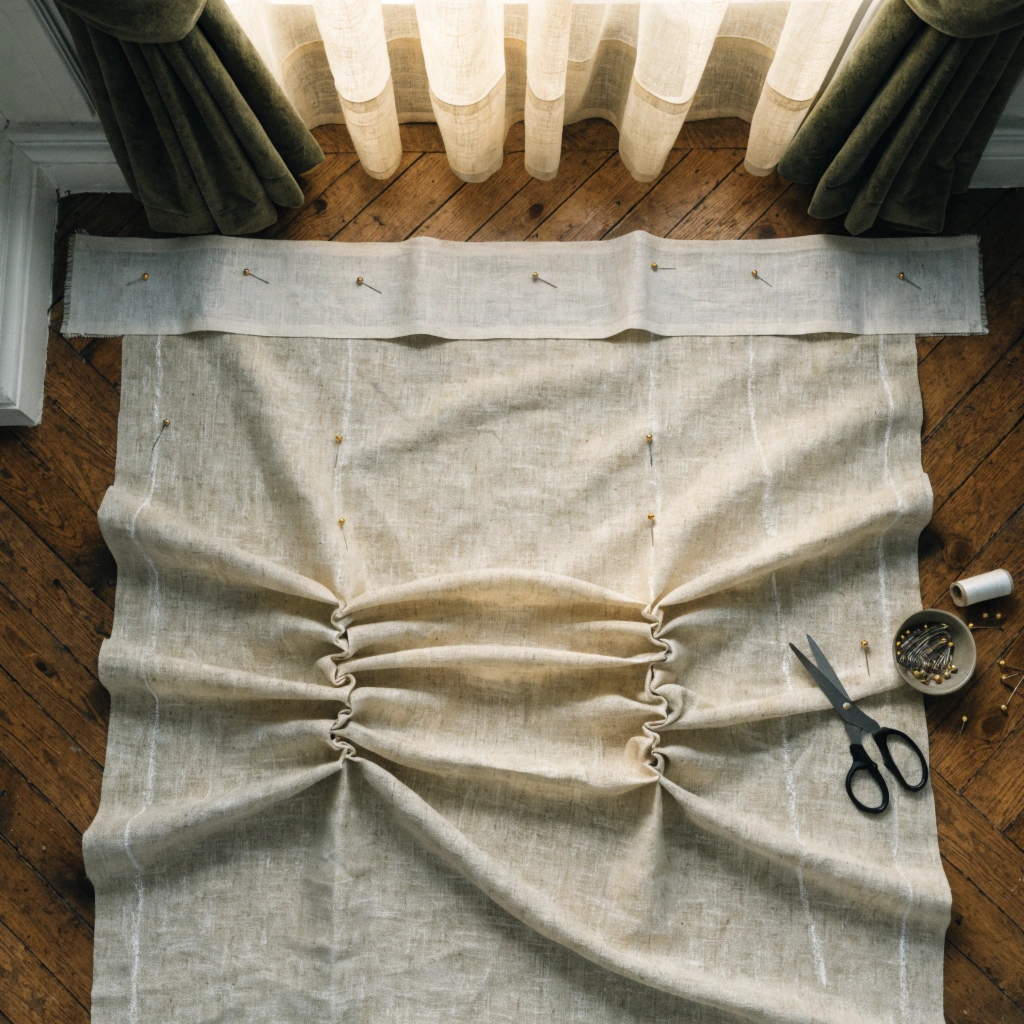
If you want a deeper tutorial, Sewing tutorials on Love Sewing Magazine UK have excellent step-by-step guides with pattern diagrams.
I] On a Standard Pole or Track
- Attach your pin hooks into the back of each pleat, ensuring they’re all at the same height (use a ruler — even a 1cm variation shows).
- Slot hooks into the curtain rings (for a pole) or the runners (for a track). Space them evenly across the heading.
- Hang the curtain and dress it — push all the fabric back to one side, then gently arrange the pleats into even columns by hand. Tie loosely with fabric ties or white cotton tape.
- Leave tied for 24–48 hours to allow the fabric to ‘train’ into position. This is the trade secret most guides skip.
II] On a Bay Window
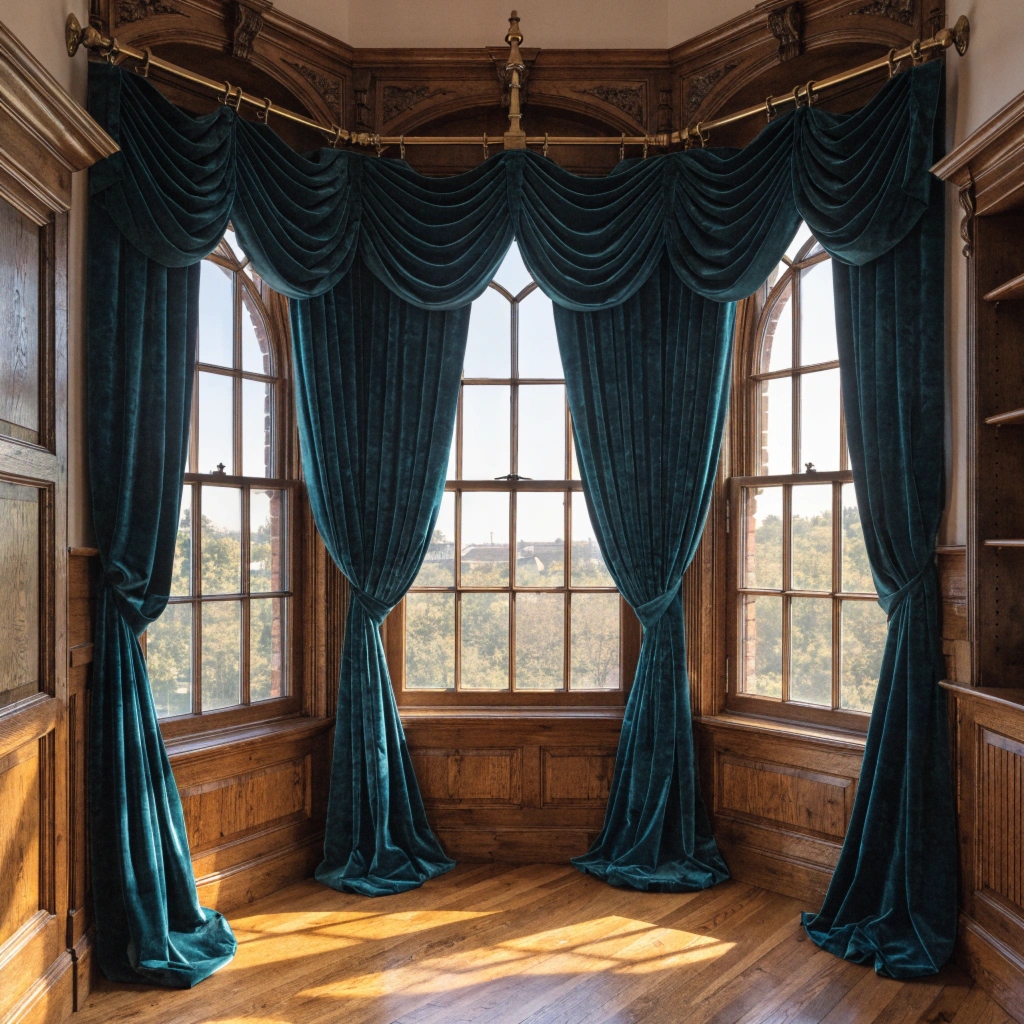
Bay windows are entirely manageable with the right hardware. You have two main options:
- Flexible track— a bendable curtain track that follows the angle of the bay. Works well for a continuous, unbroken sweep of fabric. Suppliers include Integra and Silent Gliss (available via John Lewis — Rakuten Advertising affiliate).
- Separate poles with angled brackets— each section of the bay gets its own pole, joined at internal angles with return or bay brackets. More traditional and suits period properties very well.
For either approach, the hanging method remains the same. One practical tip: if your bay has a radiator underneath, always check clearance before you commit to a full-length drop. Nothing ruins the effect of beautiful curtains faster than them sitting on a hot radiator.
Not everyone wants to make their own, and that’s absolutely fine. The ready made pinch pleat curtain market in the UK has improved enormously in recent years — you no longer have to choose between ‘affordable’ and ‘looks good’. Here are the options I’d point people towards:
Where to Buy
- John Lewis & Partners— consistently excellent quality, wide size range, superb fabrics. Their Helston and Farleigh collections are standouts.
- Dunelm— outstanding value. The Celia Pinch Pleat range gives you a proper structured heading at a fraction of designer prices.
- Laura Ashley— beautiful print options for traditional and country interiors.
- Amazon UK— useful for unusual sizes or if you need something quickly. Check verified reviews carefully for lining quality.
- Etsy UK— brilliant for semi-bespoke or handmade options, especially if you want an unusual fabric or size. Many UK sellers offer made-to-measure at reasonable prices.
| Retailer | Price Range | Best For | Affiliate Network |
|---|---|---|---|
|
John Lewis |
£80-£350 |
Quality, full range, reliable sizing |
Rakuten Advertising |
|
Dunelm |
£25–£90 |
Value, everyday use |
Awin |
|
Laura Ashley |
£70–£200 |
Traditional & floral prints |
Awin |
|
£20–£80 |
Unusual sizes, fast delivery |
||
|
Etsy UK |
£60–£250 |
Semi-bespoke, handmade |
Awin |
- Mount high, hang wide.Position your pole 15–20cm above the window frame, and extend 20–30cm beyond each side. This creates the illusion of taller, wider windows.
- Pool or not to pool.A slight break (3–5cm) or even a gentle pool (8–10cm) looks spectacular on double pinch pleats. Perfect for reception rooms. Practical rooms — kitchens, bathrooms — keep them floor-clearing.
- Line everything.Unlined double pinch pleats look almost unfinished. At the very least, use a standard cotton sateen lining. Interlined with bump for formal rooms if budget allows.
- Get the fabric weight right.Double pinch pleats look best in fabrics with some substance: linen union, wool, velvet, good quality cotton. They can look limp in very lightweight cloth.
If there’s one window treatment that will always make a room look more considered, more grown-up, and more complete — it’s double pinch pleated curtains. They suit British homes beautifully, from Georgian townhouses to suburban semis, and they’ve stood the test of time for very good reason: they simply look right.
Whether you’re rolling up your sleeves to make your own (deeply satisfying, I promise), ordering ready made pinch pleat curtains from a trusted UK retailer, or briefing a trade workroom — the principles in this guide will ensure you get the result you’re after.
Now get those pleats sorted. Your windows deserve it.
Browse our curated selection of double pinch pleat curtains, fabrics and accessories — hand-picked for UK homes.→ Shop Pinch Pleat Curtains UK ←